December 19, 2025
The Economics of Disruption: Why Education Must Pivot to "Creative Destruction"
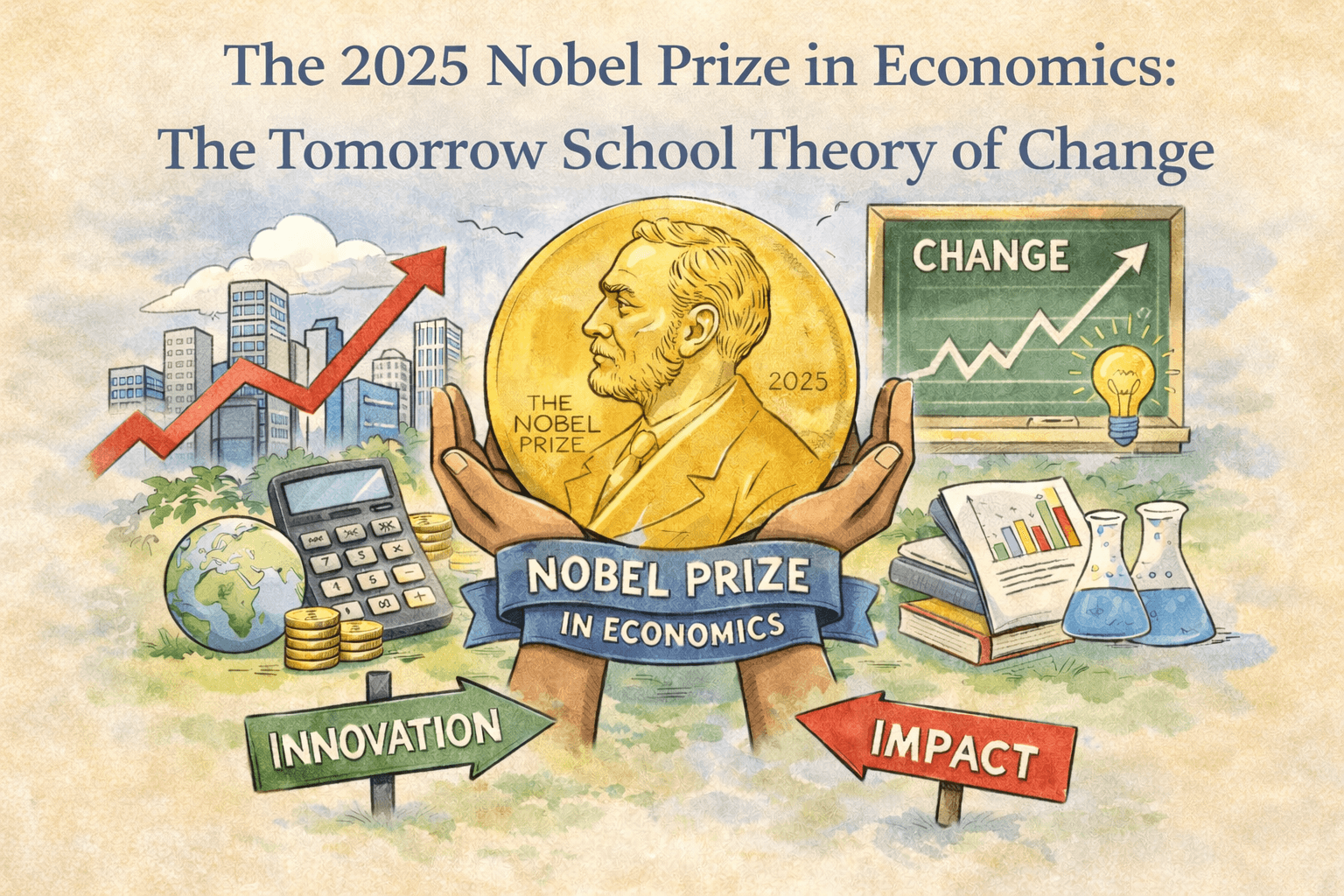
The 2025 Nobel Prize in Economic Sciences, awarded to Joel Mokyr, Philippe Aghion, and Peter Howitt, provides a rigorous framework for understanding how societies transition from stagnation to prosperity. Their work shifts the focus of growth theory away from the mere accumulation of capital (machines and labor) toward the dynamics of innovation.
For educators and policymakers, this research offers a stark warning: if our institutions—specifically schools—are designed to reward the preservation of existing knowledge rather than the systematic replacement of it, we are actively stifling the engine of long-term progress.
The Framework: Knowledge Loops and Creative Destruction
To understand the necessity of innovation at scale, we must first look at the two pillars of the 2025 Prize:
1. The Mokyr Thesis: The Culture of Growth
Joel Mokyr (Northwestern University) was awarded half the prize for his work in economic history. He investigated why sustained growth only began about 200 years ago, despite humanity having great inventions (like the printing press or the compass) centuries earlier.
Key Learnings:
The Knowledge Loop: Growth happens when propositional knowledge (science/theory) and prescriptive knowledge (engineering/practice) talk to each other. Before the Industrial Revolution, people knew that things worked but not why. When the "why" met the "how," innovation became self-sustaining.
Culture of Growth: Growth isn’t just about math; it’s about a society’s "market for ideas." Mokyr argues that a culture that rewards curiosity and challenges authority is a prerequisite for a thriving economy.
Mechanical Competence: It’s not enough to have a genius inventor; you need a workforce of skilled artisans and engineers who can build, maintain, and scale those inventions.
2. The Aghion-Howitt Model: Endogenous Growth
Aghion and Howitt formalized the concept of Creative Destruction—a term coined by Joseph Schumpeter—into a mathematical model. Their research proves that: Innovation is the primary driver of economic growth.
Innovation is inherently disruptive: New technologies render old ones (and the skills associated with them) obsolete.
The "Incumbent" Threat: Established firms (or systems) often use their power to block new entrants to protect their current profits, leading to economic stagnation. Policymakers shouldn't just protect existing jobs and companies; they must create "social insurance" for the people displaced by new technology while allowing the technology itself to move forward.
AI & The Future: This research is incredibly relevant to the current AI transition. It suggests that AI will drive massive growth only if we allow it to disrupt "incumbent" industries and if we maintain an open exchange of scientific knowledge.
The Educational Mismatch: Rewarding the Status Quo
When we apply these economic principles to modern schooling, a fundamental mismatch emerges. Most educational systems are designed for reproduction, not disruption.
Standardization vs. Variation: Standardized testing is an exercise in "propositional knowledge" without the "prescriptive" application. It rewards students for replicating existing answers. In the Aghion-Howitt model, this is equivalent to "incremental improvement" within an old technology, which eventually hits diminishing returns.
The Penalty for "Failure": Creative destruction requires a high tolerance for failed experiments. In a traditional grading system, failure is penalized with a permanent mark, discouraging the "high-variance" thinking required for radical innovation.
Institutional Incumbency: Schools often act as "incumbents." They protect established curricula and pedagogical methods because the cost of "destruction" (re-training, changing systems, or moving away from traditional metrics) is high. This mimics the "Growth Trap" identified by the Nobel Laureates.
Teaching Innovation at Scale
If we accept the Nobel Laureates' premise that growth is driven by the constant replacement of the old with the new, then education must move beyond "creativity" as a soft skill and toward innovation at scale as a technical competency.
1. From "Knowing" to "Problem-Solving Loops"
Students must be taught to manage the loop between theory and practice. Innovation at scale isn't just a "eureka" moment; it is a technical process of:
Identifying systemic bottlenecks (where the current "technology" or "method" is failing).
Rapid Prototyping (low-cost failure).
Scaling (understanding the economic and social mechanics required to replace the old system).
2. Embracing Technical Destruction
We must teach students how to intentionally render "obsolete" their own skills. As AI and automation accelerate the pace of creative destruction, the most valuable skill is no longer a specific craft, but the ability to pivot between "propositional" and "prescriptive" knowledge as the landscape shifts.
Conclusion: The Mandate for a New Generation
The 2025 Nobel Prize confirms that long-term human impact is not achieved through the maintenance of the status quo, but through the courageous, systematic replacement of it.
If we want the next generation to "change the world," we cannot continue to train them to be efficient operators of 20th-century systems. True "World-Changers" are not those who follow the rubric best; they are those who build the new systems that make the rubric irrelevant.